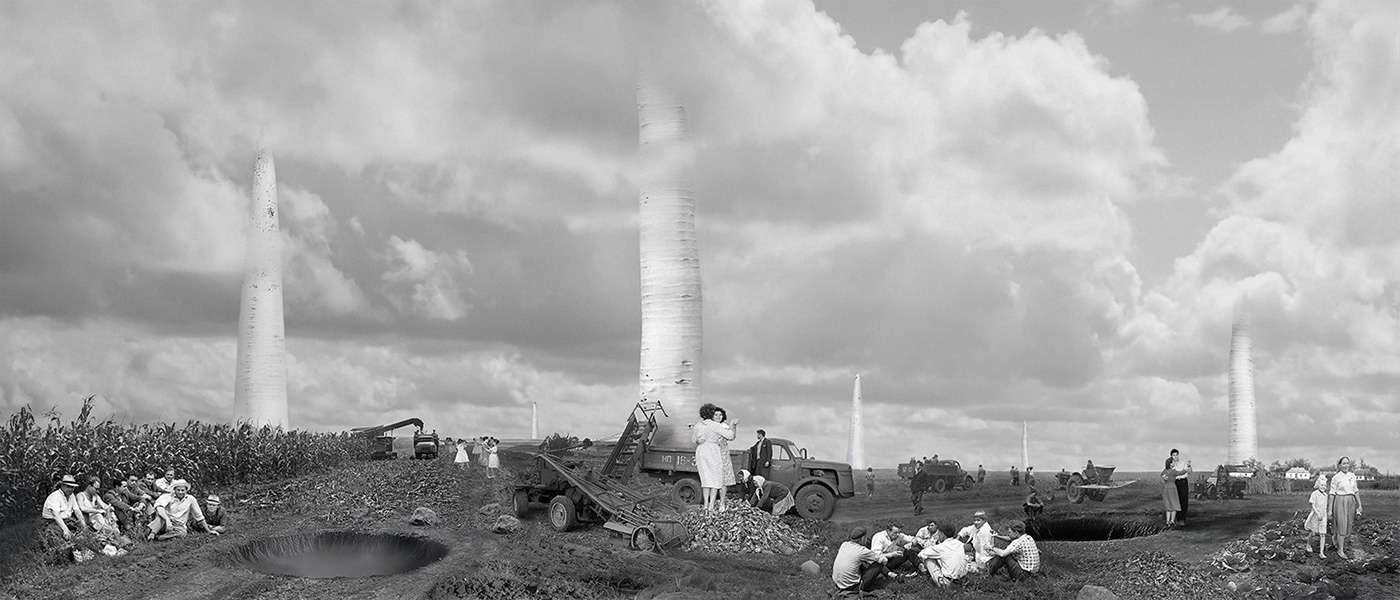
The project explores nuclear disarmament in Ukraine and its impact on landscape, memory, and collective imagination.
It focuses on the transformation of a landscape where land that once concealed nuclear weapons is now cultivated as agricultural fields. This seemingly idyllic surface coexists with the memory of the nuclear past and the reality of the ongoing war with Russia, creating tension between what is visible and what remains hidden.
During the Cold War, black Ukrainian soil concealed missiles capable of destroying the world, their presence taking root like secret vegetables underground. In 1994, Ukraine surrendered the world’s third-largest nuclear arsenal in exchange for security assurances from the United States, the United Kingdom, and Russia under the Budapest Memorandum. Eighteen years later, Russia annexed Crimea and began its war against Ukraine; in 2022, it launched a full-scale invasion.
At the former missile base near Pervomaisk, the last missile silo was destroyed in a symbolic ceremony, where Ukrainian, American, and Russian officials planted sunflowers in the black soil. The US funded the transportation of Ukraine’s nuclear weapons to Russia and built new housing for the servicemen of the 46th Missile Division. These small, American-style wooden houses still stand on the outskirts of Pervomaisk, surrounded by Soviet-era neighborhoods.
Today, the former base is the Museum of Strategic Missile Forces. Former officers work as guides, taking visitors into the underground launch control bunker, where they can press a simulated “red button” to trigger a missile launch. The tour ends beside the casing of one of the most powerful nuclear missiles ever built, known as “Satan.”
The lack of information surrounding the disarmament created fertile ground for folklore. Local rumours claimed that the land had become less fertile, cows produced less milk, and “potatoes of strange shapes with a metallic taste” began to grow. Meanwhile, some residents collected and sold leftover military materials as scrap.
The project combines panoramic photomontage based on 1970s–80s archives, transformed television footage from 1996, contemporary photographs, Google Maps collages, and oral testimonies from local residents. Lead-cast vegetables can be exhibited as objects, turning the myth of “iron potatoes” into a physical form.
______________
Фотографічний проєкт «Велика угода» є дослідженням і художньою рефлексією на тему ядерного роззброєння України та його наслідків для ландшафту, пам’яті й колективної уяви. У 1996 році Україна офіційно втратила статус ядерної держави. Під тиском і за посередництва США вона добровільно передала Росії 176 міжконтинентальних балістичних ракет, 43 стратегічні бомбардувальники та понад 5000 ядерних зарядів в обмін на гарантії недоторканності. Через 18 років Росія анексувала Крим і окупувала частину Донбасу, а у 2022 році розпочала повномасштабне вторгнення в Україну.
Проєкт фокусується на парадоксальній трансформації ландшафту: земля, яка колись приховувала стратегічно важливу й небезпечну зброю, сьогодні засаджена полями. Ця ідилічна поверхня співіснує з історичною пам’яттю про ядерний арсенал і сучасною реальністю війни з Росією, створюючи напруження між видимим і прихованим.
Робота над проєктом триває